

FibroScan for Fatty Liver: Does It Really Work?
You just found out you have a fatty liver. Maybe your doctor mentioned it casually after a blood test or an ultrasound — and now you’re left wondering what it actually means for your health.
Here’s something most people don’t know: fatty liver disease affects nearly 1 in 4 people worldwide. In India, studies suggest that close to 38% of urban adults have some form of it. And the scary part? Most of them feel completely normal.
No pain. No fatigue. No warning signs.
That’s exactly why your doctor may have recommended a FibroScan — a simple, painless test that can tell you far more about your liver than a regular ultrasound ever could. If you’re wondering whether FibroScan for fatty liver actually works, this article gives you straight, honest answers.
What Is a FibroScan?
A FibroScan test is a quick, non-invasive liver scan. It takes about 10 minutes, requires no needles, no sedation, and no hospital stay. You lie down, a probe is gently placed on your skin near the liver, and the machine does all the work.
It measures two important things:
- How stiff your liver is — stiffness means scarring (called fibrosis)
- How much fat is in your liver — measured through something called the CAP score
A standard ultrasound can spot fat in the liver, but it cannot tell you how much fat is there or whether the liver has started to scar. FibroScan fills that gap — quickly and comfortably.
Why Fatty Liver Needs More Than Just an Ultrasound
Fatty liver disease (NAFLD) is often called a silent condition because it causes no symptoms in its early stages. But left unmonitored, it can quietly progress:
Normal liver → Fatty liver → Liver inflammation (NASH) → Fibrosis → Cirrhosis
Around 1 in 5 people with fatty liver will develop NASH over time. And once fibrosis sets in, the liver begins to lose its ability to function properly.
The problem with a basic ultrasound is that it can confirm fat is present — but it can’t stage the disease or tell you how far along the damage is. That’s where FibroScan for fatty liver becomes genuinely useful.
What Do FibroScan Results Actually Mean?
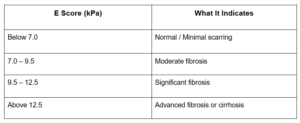
Your FibroScan results come in two scores:
Liver Stiffness Score (E Score)
CAP Score (Fat Level)
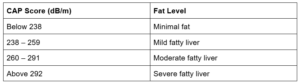
Your gastroenterologist reads both scores together with your blood tests and medical history before drawing any conclusions. Numbers alone don’t tell the whole story — clinical context matters.
Is FibroScan Accurate for Fatty Liver?
Yes — and clinical studies consistently back this up.
Research published in the Journal of Hepatology found FibroScan carries over 85% accuracy in detecting significant liver fibrosis in NAFLD patients. It also reliably measures liver fat through the CAP score, something a regular ultrasound simply cannot do.
That said, a few things can affect accuracy:
- Very high body weight (an XL probe is used in these cases)
- Eating within 2 hours of the test
- Active liver inflammation from acute hepatitis
Always fast for at least 2–3 hours before your FibroScan test and let your doctor know about any recent illness or medications.
FibroScan vs Liver Biopsy — Do You Really Need a Biopsy?
For years, liver biopsy was the only reliable way to assess liver scarring. But it involves a needle, carries a small risk of complications, and requires recovery time.
FibroScan for fatty liver has changed that for most patients:
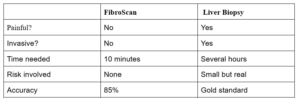
For the majority of fatty liver patients, FibroScan gives enough information to guide treatment — no needle required. A biopsy is only recommended when results are unclear or additional clinical detail is needed.
Can FibroScan Track Treatment Progress?
This is one of the most useful — and often overlooked — benefits of FibroScan.
Once you start managing fatty liver disease through diet, exercise, or medication, your doctor can repeat the scan every 6–12 months to check whether:
- Your liver fat (CAP score) is going down
- Scarring is stabilising or improving
- Your treatment plan is actually working
Seeing your numbers improve is one of the most motivating things for patients. It turns an abstract health goal into something real and measurable.
Who Should Get a FibroScan?
You may benefit from a FibroScan test if you:
- Have been told you have fatty liver on an ultrasound
- Have raised liver enzymes (ALT or AST) in blood tests
- Are living with Type 2 diabetes, obesity, or metabolic syndrome
- Drink alcohol regularly and want to check your liver health
- Have a family history of liver disease
- Are a hepatitis B or C patient needing fibrosis assessment
Frequently Asked Questions
1. Is FibroScan painful?
No. You will feel a very mild vibration on your skin. That’s all — no needles, no discomfort.
2. How long does the test take?
he scan itself is about 10 minutes. With consultation, allow 30–45 minutes total.
3. Can FibroScan detect early fatty liver?
Yes. The CAP score can detect even mild fat accumulation that a standard ultrasound might miss.
4. How often should I repeat it?
Every 6–12 months if you are actively managing fatty liver disease.
5. Can it replace a liver biopsy?
In most fatty liver cases, yes. A biopsy may still be needed in specific or complex situations.
Take the Next Step for Your Liver Health
If you have been diagnosed with fatty liver — or if your blood tests have raised concerns — the right time to act is now, not when symptoms appear.
Digestive Endoscopy Clinic in Pune, founded by Dr. Suresh Jain, is a trusted name in gastroenterology care in the city. The clinic offers FibroScan testing along with thorough liver evaluation, honest result interpretation, and a clear treatment path suited to your condition.
Dr. Suresh Jain and his team take the time to explain your results in simple language, answer your questions, and help you understand what your liver health actually looks like — so you can make informed decisions about your care.
Book your FibroScan consultation at Digestive Endoscopy Clinic, Pune today. Your destination for Gastroenterology treatment in Pune — Founded by Dr. Suresh Jain