

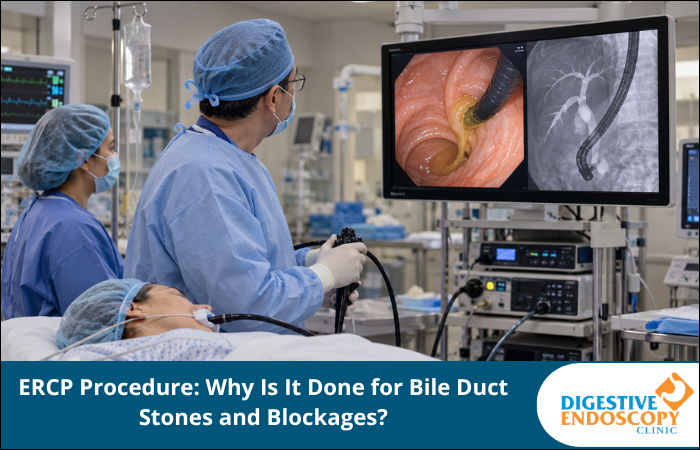
ERCP Procedure: Why Is It Done for Bile Duct Stones and Blockages?
When bile cannot flow freely from the liver to the intestine, people often notice yellowing of the skin, dark urine, pale stools, fever, or upper abdominal pain. In many cases, a stone or narrowing is blocking the bile duct. An ERCP procedure can confirm the problem and treat it in the same sitting, which is why it is often recommended for bile duct stones and blockages.
What Is an ERCP Procedure?
ERCP stands for Endoscopic Retrograde Cholangiopancreatography. It is a specialised endoscopy that looks at the bile ducts and pancreatic duct.
A thin, flexible tube with a camera (endoscope) is passed through the mouth into the stomach and the first part of the small intestine (duodenum). From a tiny opening called the papilla, the doctor places a fine catheter into the duct system, injects contrast dye, and takes X-ray images. If a stone or blockage is found, it can often be treated right then.
Unlike a scan that only shows pictures, ERCP treatment can diagnose and treat many duct problems in one procedure.
Why Is ERCP Done for Bile Duct Stones?
Gallstones usually form in the gallbladder. Sometimes a stone moves into the common bile duct and gets stuck, stopping bile flow and sometimes causing infection.
Doctors may advise ERCP when:
- Imaging (ultrasound, CT, or MRCP) suggests a bile duct stone
- Blood tests show raised bilirubin and related liver enzymes
- There is jaundice with pain, fever, or chills
- Stones remain in the bile duct after gallbladder surgery
- Drainage of the duct is needed before or after gallbladder surgery
During ERCP, the doctor can enlarge the duct opening (sphincterotomy) and remove stones with a basket or balloon. If needed, a temporary stent may be placed to keep bile flowing.
Reading about when you may need ERCP can help you prepare questions for your consultation.
Why Is ERCP Done for Bile Duct Blockages?
Not every blockage is caused by a stone. The bile duct can also narrow because of:
- Strictures (scarring or narrowing of the duct)
- Inflammation related to pancreatitis or prior surgery
- Growths or tumours pressing on or arising from the duct
- Complications after gallbladder surgery
When bile is blocked, it can back up into the liver and cause jaundice and infection. ERCP lets the doctor see the narrowing, take tissue samples if needed, and place a stent to restore drainage.
ERCP is also used for selected pancreatic duct problems. See signs of pancreatic problems if those symptoms are a concern.
How Does the ERCP Procedure Work?
Before the procedure
You will usually fast for several hours (often about 8 hours; follow clinic instructions), share your full medicine list (especially blood thinners, anti-inflammatory drugs, aspirin, insulin, and vitamin E), mention allergies to medicines, iodine, or shellfish, and arrange for someone to accompany you home after sedation.
During the procedure
Most patients receive sedation. You typically lie on your left side with a mouthguard in place. Contrast dye is injected and X-rays are taken. Treatment may include stone removal, sphincterotomy, biopsy, or stent placement. Procedure time varies with complexity.
After the procedure
You will be observed until sedation wears off. Mild throat discomfort, bloating, or drowsiness is common briefly. See post-endoscopy care tips for rest, diet, and follow-up guidance.
Benefits of ERCP for Stones and Blockages
For suitable patients, ERCP offers:
- Diagnosis and treatment in one sitting
- Avoids open surgery for many bile duct stones
- Can relieve jaundice by restoring bile flow
- Allows stent placement when the duct is narrowed
- Can obtain tissue samples when the cause is unclear
ERCP is not right for everyone. Doctors may start with blood tests and imaging, then choose ERCP when duct treatment is likely needed. More context is in common digestive disorders diagnosed through endoscopy.
Risks and Precautions to Know About
ERCP risks can include pancreatitis, bleeding (especially after sphincterotomy), bile duct infection, perforation, and reactions to sedation. Individual risk depends on your anatomy, the reason for ERCP, and other health conditions.
Discuss ERCP precautions and risks beforehand so you know what to expect and when to seek urgent help.
Contact your doctor promptly for severe abdominal pain, persistent vomiting, fever or chills, black or bloody stools, chest pain, or difficulty breathing after ERCP.
What Recovery Usually Involves
Adults usually go home the same day once sedation has worn off, unless admission is advised. Rest for the remainder of the day. Avoid driving or making important decisions while sedative effects remain.
Your doctor will guide diet, medicines, antibiotics if needed, and stent review timing if a stent was placed. Recovery may take a day or two after straightforward stone removal, and longer if infection or a complex blockage was present.
Frequently Asked Questions About ERCP
1. Is ERCP the same as a normal endoscopy?
No. A standard gastroscopy examines the food pipe, stomach, and duodenum. An ERCP procedure also examines the bile and pancreatic ducts with contrast dye and X-rays, and often includes treatment.
2. Can ERCP remove bile duct stones without open surgery?
Yes, many bile duct stones can be removed during ERCP. Very large or difficult stones may need more than one session or additional techniques.
3. Will I be awake during ERCP?
Most patients receive sedation. Mild throat soreness afterward is common.
4. What symptoms suggest a bile duct blockage?
Jaundice, dark urine, pale stools, itching, fever, chills, and upper abdominal pain can all point to a blocked bile duct and need timely review.
5. Is ERCP always needed if I have gallstones?
No. Stones limited to the gallbladder are often managed differently. ERCP is typically considered when stones or blockages involve the bile duct.
6. When should I seek emergency care after ERCP?
Seek urgent care for severe abdominal pain, high fever, repeated vomiting, vomiting blood, black stools, shortness of breath, or sudden chest pain.
When to Consult Dr. Suresh Jain
If you have jaundice, suspected bile duct stones, unexplained duct narrowing, or have been advised ERCP after tests, timely specialist review matters.
Dr. Suresh Jain is a gastroenterologist in Pune with more than 28 years of experience in diagnostic and therapeutic GI endoscopy. His training includes MBBS and MS (General Surgery) from Grant Medical College, a Fellowship in Therapeutic GI Endoscopy, and certified endosonography training at the University of Alabama and South Carolina, USA. He performs gastroscopy, colonoscopy, sigmoidoscopy, ERCP, EUS, and other therapeutic endoscopic procedures at Digestive Endoscopy Clinic.
Digestive Endoscopy Clinic locations:
- Rasta Peth: Khopkar Heights, 103/A, Quarter Gate Chowk, Opp. YMCA Club, Rasta Peth, Pune, Maharashtra 411002. Phone: 020 2613 0932
- Bibwewadi: Apex Business Court, 411, Bibwewadi Kondhwa Rd, Market Yard, Ganga Dham, Pune, Maharashtra 411037. Phone: +91 7972242754
Other contacts: 7020453142, 9822335381; email drjainsuresh1969@gmail.com. Hours (as listed): Mon-Fri 10:00 AM-3:00 PM and 4:00 PM-6:00 PM; Saturday evening and Sunday closed.
To book an appointment, visit the clinic contact page or call the numbers above.